
Mastering the Fundamentals of Legislative Success
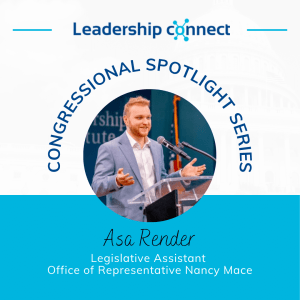
This week, we spoke to Asa Render, Legislative Assistant for the Office of Representative Nancy Mace.
Can you walk us through your career path and the steps that led you to your current role as a Legislative Assistant?
Like many college athletes, I was initially pushed toward a career in sports or sports business. However, everything changed after a freshman-year internship in early 2019 with the Republican Party of Kentucky, where I discovered my passion for politics and government. Throughout the remainder of my college career, my interest grew substantially after completing eight additional internships. In 2021, I wrote “I will be a full-time Capitol Hill staffer” on a sticky note that I still carry in my wallet to this day.
In Summer 2022, I earned the opportunity to move to D.C. and intern for Representative Thomas Massie. It reaffirmed my interest in working on Capitol Hill full-time. However, converting this to a full-time role wasn’t easy. Unable to land a Hill role directly after my internship, I sent out 365 applications across Capitol Hill, communications, and government affairs roles, and was rejected from all but one. That one was the National Fraternal Order of Police, who brought me on as a Legislative Liaison. I appreciated the purposeful, meaningful work advocating for our nation’s law enforcement officers, and I learned a lot from the experience, but it still wasn’t Capitol Hill.
Determined to prove the sticky note right, I sent out another 1,015 applications before returning to Representative Massie’s office as a Staff Assistant. I then joined Representative Nancy Mace’s office as a Legislative Correspondent and was later promoted to Legislative Assistant. No part of my journey has been easy, but it’s definitely been worth it.
Which policy areas or legislative issues are you most passionate about and how do you stay informed and engaged in those specific areas?
I currently cover the domestic portfolio for Representative Mace and act as an advisor on Agriculture, Animals, Art, Culture, Education, Emergency Management, Environment, Family, Food, Health, Postal, Religion, Renaming, Small Business, Social Welfare, Statues, and Veterans Affairs issues. Having previously worked for the National Fraternal Order of Police, I additionally have a strong background covering law enforcement, homeland security, and crime policy.
While all these issues hold a unique and important place in my heart, my strongest current pull is toward federal government oversight (transparency) and First Amendment issues. The rights enumerated in the First Amendment are foundational to our republic, and as a publicly funded institution, the federal government has a strong obligation to be both a responsible steward of taxpayer dollars and public trust.
The best way I stay informed on policy developments and breaking news facing these issues is through interpersonal communication. In my experience, a Google search will only take you so far, and AI still makes mistakes. Identifying stakeholders embedded within the respective policy world and cultivating strong, mutually beneficial relationships ensures that you remain in the loop and can receive expert input when working with the more parochial aspects of a portfolio.
Describe a challenging or rewarding project that significantly influenced your growth as a professional. How did you handle the challenge and how did it shape your approach to legislative work?
Writing and introducing a bill is formulaic once you nail down the process, but the first time you do it, it can be pretty difficult. My first time was not exactly a walk in the park. As a disclaimer, the standards and expectations of how involved a staffer is in this process vary both by the staffer and the office in question.
Introducing a bill requires three things: a constitutional authority statement, original cosponsor form, and the finalized bill text. While the first two materials are relatively straightforward, developing bill text is a much more involved process. For a substantive bill, after cementing your idea, it most often requires close collaboration with two internal stakeholders: the Office of Legislative Counsel (OLC), lawyers to provide legal expertise and drafting support to staff, and the Congressional Research Service (CRS), whose subject matter experts can speak to policy specifics and identify key statutory references. While their perspectives may seem to be complementary (which they sometimes are), they can have opposing views on the best way to achieve your legislative goal, or even on whether a certain drafting strategy does what you want it to do. If so, you will need to weigh both sides and decide which approach is the most beneficial to accomplish your legislative goal. Staffers do have the ability to write a bill without collaborating with either entity, but it tends to be best practice to run your work by them at the very least. Why not consult the experts, right?
Finally, once the bill is finalized, you’ll need to navigate the internal dynamics of your office. Will senior staff and the boss sign off on this? Will they think I should’ve created a new subchapter or amend an existing one? Will they tell me to rewrite this in the jurisdiction of another committee for strategic reasons?
Every step listed requires specific processes and requirements, which make it anything but simple. The first time I navigated this process, it was entirely unfamiliar. Mistakes were made, drafts snowballed, and reaching the final product took far longer than expected. To address this challenge, I sat down with more experienced staffers both in my office and externally to identify the correct portals, POCs, and resources. Most importantly, I learned that it is acceptable, even necessary, to say “I don’t know” when working alongside subject matter experts and lawyers. While face-to-face dialogue is important during complex projects, it is only effective when all parties involved are candid. It is a much worse outcome if drafting continues based on incorrect or incomplete information because you didn’t want to look silly and admit that you weren’t sure.
What’s one piece of advice you would offer to those hoping to succeed as a legislative staffer on Capitol Hill?
I very strongly recommend reading “Congressional Procedures and the Policy Process” by Walter J. Oleszek, Mark J. Oleszek, Elizabeth E. Rybicki, and William Alan Heniff. If you are currently interning or working in a Congressional office, chances are that a legislative staffer will have a copy on hand you can borrow.
To give a second suggestion, I would tell legislative hopefuls to master the basics first. Networking and other aspects of the role are very important, but don’t lose the forest for the trees. Particularly in the legislative corner of Capitol Hill, it’s not as much of a “grow-into-the-role” environment as many others are; you will need to show you have the core skills for the job. Most fundamentally, this means solid legislative writing skills, competency in bill and law analysis, and a comprehensive understanding of how to navigate the political fights surrounding policy issues within your portfolio.
What do you believe sets Capitol Hill apart as a unique work environment, and how do you navigate its challenges in your everyday work?
Often, the hardest part of the job is that certain aspects are intangible and rely heavily on soft skills. Hiring is not always based on meritocracy; more often, it is based on cultivated or existing relationships. This also works in the inverse. Your job can be in danger based on more intangible metrics like your relationships and standing in the office. To be clear, you can’t survive on this alone. Being competent and owning your role is a precondition to employment. The relationships factor is simply an additional layer to the game. I believe there is only one simple way to approach this: talk to everyone and make enemies with no one.
However, this should not be too much of a stress point for new staffers. The Hill tends to self-select for “nice,” as Capitol Hill is a fundamentally social machine, and its incredibly visible environment tends to weed out jerks. Throughout my experience, I have found staffers to be intelligent, kind, diplomatic, and reasonable. Work hard, be nice, and don’t make any enemies by saying something stupid. It will take a little bit of self-awareness, but you’ll be fine.
Word association, what is the first word that comes to mind for each of these?
Policy: Solution
Networking: Critical
Writing Skills: Irreplaceable
Working on the Hill: Purposeful
Leadership Connect: Useful
DISCLAIMER: The views expressed in this written interview reflect a general sense of Congressional work and are not necessarily attributable to any current or former Member of Congress. All comments are personal to the interviewee and do not reflect the positions, policies, or views of any current or former Member of Congress, Congressional office, or any other governmental body or agency.